
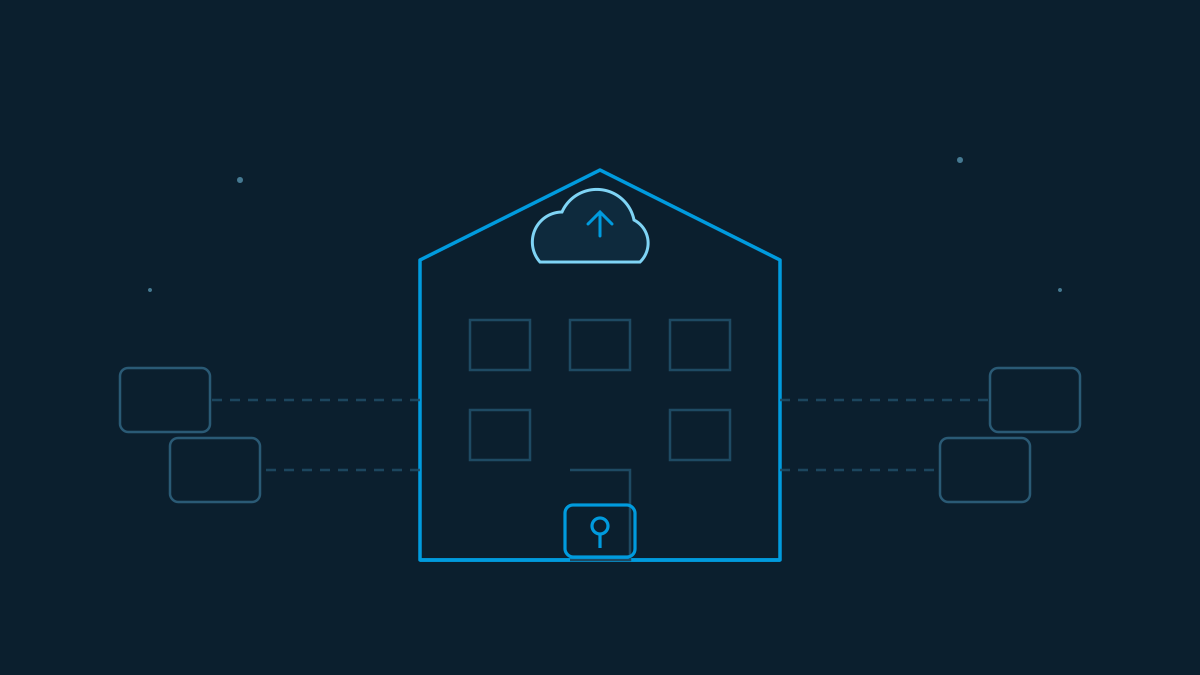
There is a question most software vendors hope you never ask: if we part ways, what exactly do I keep? For a decade the SaaS industry's honest answer has been "an export button, if you're lucky." For businesses in regulated sectors — legal, health, maritime, finance — that answer is increasingly unacceptable. Our answer is architectural: Bring Your Own Storage.
The centralization default
Standard SaaS economics push vendors to centralize: one multi-tenant database, one storage bucket, everyone's data in the vendor's account. It is efficient for the vendor. For the client it creates three structural risks:
- Custody risk. Client files — contracts, medical records, certificates — legally under the client's responsibility, physically under the vendor's control.
- Continuity risk. If the vendor shuts down, gets acquired or has an outage, the client's operational history is hostage to someone else's runbook.
- Compliance risk. Data-protection regimes increasingly care about where data lives and who can access it. "In our provider's cloud, somewhere" is a poor answer to a regulator.
Inverting the model
BYOS inverts the relationship: the application comes to the data, not the data to the application. The client owns the storage — their cloud bucket, their drive, their server — and the software operates on it with credentials the client grants and can revoke.
Designing for this is genuinely harder than centralizing, which is why it is rare. It requires:
- A storage abstraction layer — the application logic must not care whether the backing store is a client's cloud bucket, a corporate drive or an on-premise volume.
- Credential discipline — the vendor holds delegated, scoped, revocable access; never root keys to a shared pool.
- Metadata/payload separation — the system can index and compute over data it does not custody, keeping heavy and sensitive payloads in client territory.
- An exit that is a feature, not a lawsuit — when the contract ends, the client's storage is already theirs; there is nothing to migrate.
What it changes commercially
BYOS turns a sales objection into a differentiator. Mid-market companies in Latin America are rightfully skeptical of handing operational data to a small vendor — they have seen vendors disappear. "Your data never leaves your infrastructure" is a sentence that closes deals precisely because most competitors cannot say it.
Ownership is not an export button. Ownership is when leaving your vendor requires no migration at all.
Key takeaways
- Centralized SaaS storage creates custody, continuity and compliance risk for regulated clients.
- BYOS means the application operates on client-owned storage with revocable, scoped credentials.
- It demands a storage abstraction layer and metadata/payload separation from day one.
- The exit experience is the truest measure of data ownership.
Working in a regulated industry and wrestling with the problems described here? We build software for exactly this.
Talk to PBS