
Enterprise software has a cost problem that hits mid-market companies hardest: every industry believes it is unique, so every industry pays to rebuild the same modules with different labels. An invoicing engine, a document repository, a scheduling system and an approval workflow are 80% identical whether they serve a law firm, a shipping agency or a distribution warehouse. The remaining 20% — the domain logic — is where the industry actually lives. Our entire portfolio is built on taking that ratio seriously.
The shared chassis
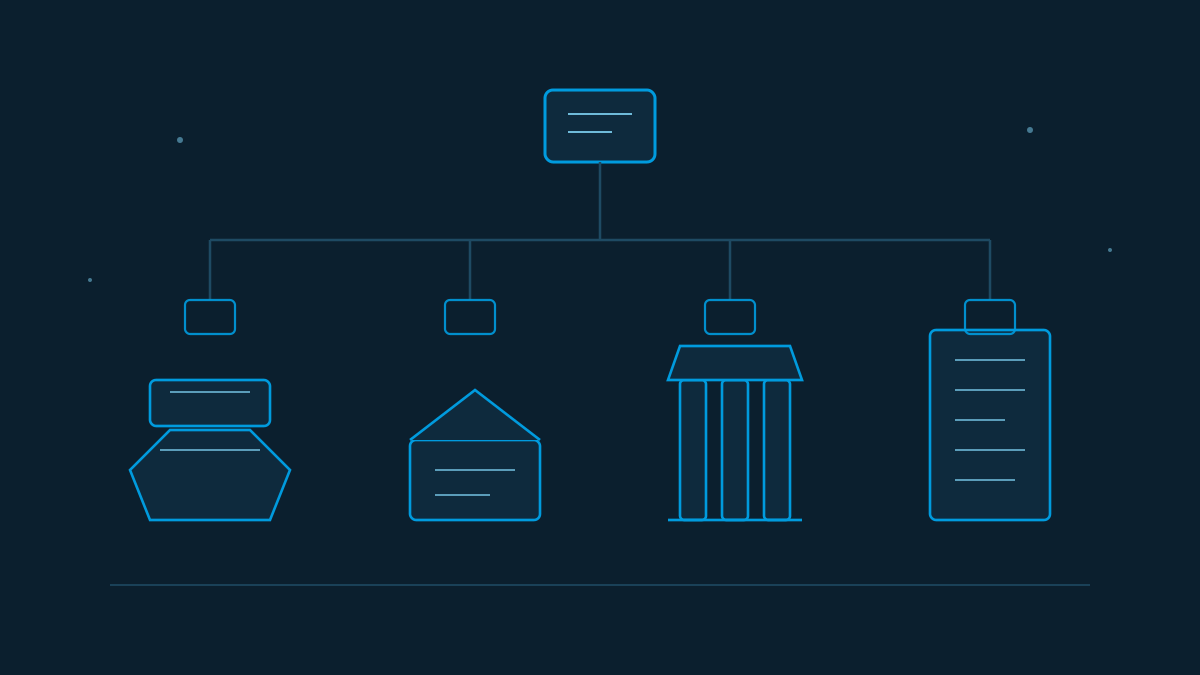
We maintain one modular chassis — authentication, document management, scheduling, notifications, reporting, billing — and deploy it across four verticals: maritime operations, legal practice, logistics, and commercial back-office. Each vertical gets the 20% that makes it itself: compliance catalogs for maritime, case workflows for legal, routing for logistics. Our public Enterprise Portal and demo gallery are the visible surface of this: distinct products, one architecture underneath.
What the client actually gains
- Cost compression. A module amortized across four industries costs each client a fraction of bespoke development. This is the difference between "enterprise software" being accessible to a 50-person company or only to a multinational.
- Maturity by inheritance. When the document module gains an audit trail because a maritime client needed it for inspections, the legal vertical inherits it in the next cycle. Every industry's hardest requirement raises the floor for the others.
- One fix, every deployment. A vulnerability patched in the chassis is patched everywhere. Compare that with the agency model, where each bespoke build drifts into its own unpatched dialect.
The discipline it demands
Modularity fails when it is only a slogan. Three rules keep it real for us:
1. The chassis never contains domain logic
The moment "if maritime, then…" appears in a shared module, you no longer have a platform; you have four codebases in a trench coat. Domain rules live in per-vertical layers and configuration catalogs.
2. Tiers, not custom builds
We structure offerings in tiers — personal tools, digital workspace, industrial ERP — so a client grows by activating modules, not by commissioning rewrites. The upgrade path is configuration.
3. Divergence is a decision, not an accident
Sometimes a vertical genuinely needs to fork a module. That is allowed — as a recorded architectural decision with an owner, not as Tuesday-afternoon drift. Unmanaged divergence is how platforms quietly die.
Why this matters in Latin America specifically
The LatAm mid-market is chronically underserved: too complex for spreadsheet-plus-WhatsApp operations, priced out of global ERP suites and their implementation armies. Modular architecture is what makes the middle path economically viable — industrial-grade software at a regional cost structure, in Spanish, built around regional regulation.
Key takeaways
- Most "industry-specific" software is 80% generic modules, 20% domain logic.
- Amortizing the 80% across industries is what makes enterprise software mid-market affordable.
- The chassis must stay domain-free; divergence must be a recorded decision.
- Every vertical inherits the hardest requirements of its siblings.
Working in a regulated industry and wrestling with the problems described here? We build software for exactly this.
Talk to PBS